Frequently Asked Questions
We believe informed choices begin with good information. Here are answers to some of the questions we hear most often. If you don’t find what you’re looking for, we’d love to connect during a consultation.
-
We recommend scheduling a consultation as early in pregnancy as you’d like. Most reach out after receiving a positive pregnancy test (often even before their husbands know!). There’s no “perfect” time, but because we intentionally limit the number of families we care for each month, reaching out earlier gives you the best chance of securing a spot on our calendar.
Our consultations are relaxed, pressure-free conversations. They’re an opportunity for us to get to know one another, answer your questions, and determine whether our philosophy and approach to care feel like the right fit for your family.
-
All of our prenatal appointments take place in the comfort of your home. Rather than asking you to come to an office, we come to you.
Over the course of your pregnancy, we have the privilege of getting to know not only you, but also your family, your children, your pets, and the environment where you’ll welcome your baby. We believe there’s something special about meeting in a space where you’re already comfortable. It allows us to see the little pieces of your life that make your family unique and helps us build a relationship that extends far beyond routine prenatal care.
Because we travel to every appointment, we don’t schedule families back-to-back. We ask that you allow a 30-minute arrival window before and after your scheduled appointment time. Traffic, weather, and the needs of the family before you can occasionally affect our arrival time. If a mother needs a little extra time, we never want to rush her out the door, just as we would never want to rush through your appointment.
We intentionally limit the number of families we care for so that our visits feel like conversations, not checklists. Our goal is for you to leave each appointment feeling heard, informed, and cared for.
-
In many cases, yes.
Families transfer into our care for many different reasons. Some have recently moved to the area, while others discover that home birth or our practice feels like a better fit later in pregnancy.
The timing of your transfer, your medical history, and our availability all play a role. We encourage you to reach out, and we’ll be happy to discuss your individual situation.
-
Your initial prenatal visit is our longest appointment, typically lasting 1½ to 2 hours. During this visit, we take time to thoroughly review your health history, get to know you and your family, and catch up on everything that’s happened during the first trimester. Since we often don’t see families until around 10 to 11 weeks of pregnancy, there’s a lot to discuss.
We’ll also review and sign all of our practice documents together, answer any remaining questions, and make sure we’re all on the same page before moving forward. This is also the visit when your initial deposit, or your discounted paid-in-full fee, is due depending on the payment option you’ve selected.
After your initial visit, we follow the traditional prenatal schedule for the frequency of appointments. Most routine prenatal visits last 30 to 60 minutes, depending on your individual needs. We intentionally avoid rushing appointments because every family and every pregnancy is different. If you need extra time, we’re happy to take it. We believe some of the best conversations happen when no one is watching the clock. -
Absolutely! We love meeting the entire family. Pregnancy isn’t just about growing a baby, it’s about growing a family, and we believe the people who will be part of your birth should have the opportunity to be part of your prenatal care as well.
We especially encourage partners to attend appointments whenever possible. We believe your partner is one of the most important members of your birth team. During labor, they are often your steady presence, your greatest encourager, and what we like to call your slow oxytocin drip. Feeling safe, loved, and supported by your partner can play a powerful role in helping labor unfold naturally.
When partners attend prenatal visits, they have the opportunity to ask questions, better understand the physiology of birth, and hear the same information you do. By the time labor begins, everyone is on the same page and feels more prepared and confident in the journey ahead.
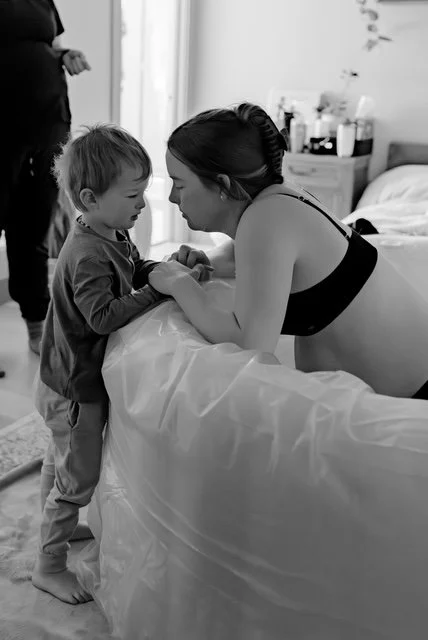
And of course, children are always welcome too! One of the greatest joys of providing prenatal care in your home is getting to know your whole family, including the little ones. We love watching siblings prepare for their newest family member and seeing your family grow together. -
The only test we require for all of our clients is knowing your blood type.
Beyond that, we believe healthcare decisions should be made by informed parents, not by routine. Throughout your pregnancy, we’ll thoroughly discuss the purpose, benefits, limitations, risks, and alternatives of the various screenings, tests, and ultrasounds available to you and your baby.
These conversations include topics such as genetic screening, first trimester labs, the 20-week anatomy ultrasound, gestational diabetes screening, Group B Strep testing, routine prenatal labs, newborn medications and screenings, and more.
Some families choose every recommended screening and test. Others choose very few or none at all. Our role isn’t to make those decisions for you. Our role is to ensure you have balanced, evidence-informed information so you can make the decision that feels right for you, your family, and this baby.
-
You are never required to accept a test, screening, or procedure simply because it is routinely offered.
At Pangaea, we believe every family deserves the opportunity to make informed decisions about their care. Our role is to provide balanced, evidence-informed education, answer your questions, and discuss the benefits, limitations, risks, and alternatives of each option. From there, the decision is yours.
Some families choose every recommended screening and test, while others choose very few or none at all. Every pregnancy is unique, and every family has different values, experiences, and priorities. We are committed to respecting your decisions while continuing to provide safe, individualized care within the scope of Idaho law and midwifery practice.
We believe informed choice isn’t about telling you what to do. It’s about ensuring you have the knowledge and support to make the decision that’s right for you, your family, and your baby.
-
Yes! We are experienced in supporting both water labor and water birth.
If laboring or giving birth in water is part of your birth plan, we’ll provide one of our beautiful white Earthside Birth Pools during your 36-week prenatal visit. The use of the birth pool is included in the cost of your care, so there’s no need to rent or purchase one separately.
After your birth, we’ll take care of everything. We pump the pool out, thoroughly clean and sanitize it, and take it with us before we leave, allowing you to simply focus on resting and enjoying those first moments with your new baby.
Throughout your prenatal care, we’ll discuss the benefits, considerations, and logistics of water birth so you can decide whether it’s the right choice for your labor and birth.
-
Our first priority is always the health and safety of both mother and baby.
Most hospital transfers are not emergencies. In many cases, they occur because labor isn’t progressing as hoped, additional pain management is desired, or we believe additional evaluation or resources would be beneficial. Preparing for the possibility of transfer is simply part of planning a safe home birth.
One of the greatest benefits of working with Pangaea is the strong relationships we’ve built with the nurses, certified nurse-midwives, and OB/GYNs at our local hospitals. We work collaboratively with them and are grateful for the mutual respect we’ve developed over the years.
If a transfer becomes necessary, one of us will always go with you. We never simply send you to the hospital or drop you off at the door. We call the hospital before you arrive so the team knows you’re coming, communicate your clinical situation, and remain by your side to help ensure a smooth transition of care. Our support doesn’t end because your birth setting changes.
-
Every pregnancy and birth is unique, so transfer rates vary depending on many factors, including whether it’s a first birth or a subsequent birth. Rather than focusing on percentages, we believe it’s more important for families to understand why transfers happen and how we approach those decisions.
We have tremendous respect for the innate wisdom of both mothers and babies. We trust the physiology of birth, but we also recognize when the birth story is telling us that additional resources may be beneficial. Throughout labor, we’re constantly assessing the whole picture. Sometimes we begin to see what we like to call “pink flags.” Individually, they may not be concerning, but when several begin to appear together, they help guide our clinical judgment.
In our experience, we have never had a transfer that wasn’t warranted. Time and time again, once we’ve arrived at the hospital and more information becomes available, we’ve felt confident that it was exactly where that family needed to be. We don’t view transfer as a failure. We view it as another tool that helps us provide safe, individualized care.
It’s also important to know that Pangaea has never had an emergent hospital transfer. We believe that thoughtful, timely decision-making can reduce unnecessary trauma. Waiting too long in an effort to avoid a transfer can sometimes result in a more urgent situation, a traumatic birth experience, or a cesarean that might have been avoided with earlier intervention.
Our goal has never been “home birth at all costs.” Our goal is a healthy mother, a healthy baby, and the lowest-trauma birth experience possible. Whether your baby is born at home or in the hospital, vaginally or by cesarean, we want you to feel informed, supported, respected, and confident that every decision was made with your family’s well-being at the center.
-
Yes! We welcome families planning a vaginal birth after cesarean (VBAC) who meet Idaho’s eligibility requirements for out-of-hospital birth. Under Idaho law, licensed midwives may attend a VBAC after one prior low transverse cesarean, provided there are no other disqualifying risk factors. State law does not allow us to attend home births for families with more than one previous cesarean, a prior classical (vertical) uterine incision, or a cesarean that occurred within 18 months of the estimated due date. Idaho law also requires that clients with a previous cesarean be advised to consult with a physician during pregnancy.
VBAC does not scare us. To us, a VBAC is still a normal physiologic birth, and we care for our VBAC families with the same respect, encouragement, and individualized attention we give every other client. We also recognize that, in many ways, a VBAC can behave like a first birth. Even though you’ve had a baby before, your body may be stretching and navigating labor in new ways for the first time.
We’ve also learned that the body is incredibly intelligent. Sometimes it seems to protect a previous cesarean scar by creating a different labor pattern than we might see in someone without a uterine scar. Because of that, we’re patient. We don’t rush labor simply because it doesn’t fit a predetermined timeline. Instead, we carefully assess the entire clinical picture while allowing birth the time and space it often needs.
At the same time, we’re highly trained to recognize the warning signs that may indicate a VBAC is no longer unfolding normally. We continuously assess both mother and baby throughout labor and know when it’s appropriate to recommend additional evaluation or a hospital transfer. Our goal is never “VBAC at all costs.” Our goal is a safe, well-supported birth with the lowest-trauma outcome possible for both mother and baby.
If you’re considering a VBAC, we’d love to talk with you about your previous birth experience, answer your questions, and determine whether home birth with Pangaea is the right fit for your pregnancy.
-
One of the very first things we do during your initial prenatal visit is take a deep dive into determining your estimated due date (EDD). Rather than simply entering the first day of your last menstrual period into a calculator and assuming you have a textbook 28-day cycle, we take a much more individualized approach.
We discuss your menstrual cycle length, ovulation date, conception date (when known), early ultrasound findings, and previous pregnancy history. We even consider your family’s birth patterns, such as when your mother or sisters typically gave birth, because these details can sometimes provide helpful context. Our goal is to determine the most accurate due date possible so we’re not placing unnecessary expectations on your pregnancy.
We firmly believe that babies don’t all read the same calendar. Some babies are simply meant to come a little earlier, while others need more time. By taking the time to establish an accurate due date from the beginning, we can feel more confident that your pregnancy is progressing within a normal timeframe rather than labeling you “overdue” when you may not actually be.
As your pregnancy progresses, we’ll continue to closely monitor both you and your baby while discussing your options every step of the way. If concerns arise, we’ll talk openly about what we’re seeing and make decisions together based on the whole clinical picture, not simply a date on the calendar.
Because we practice under Idaho law, we are able to attend planned home births between 37 weeks 0 days and 41 weeks 6 days. If your pregnancy continues beyond that point, we will help coordinate a smooth transition of care so you and your baby continue to receive the support you need.
-
The postpartum period is one of our favorite parts of this journey. While birth is just one day, the weeks that follow are when a new family begins to find its rhythm, and we believe that season deserves just as much care and attention.
We provide up to six postpartum home visits over the first six weeks after birth. These visits typically take place on Day 1, Days 3 to 5, 1 week (if needed), 2 weeks, 4 weeks, and 6 weeks postpartum. Each visit is an opportunity to check on both you and your baby, answer questions, and ensure you’re recovering and adjusting well.
During these visits, we do far more than simply perform physical assessments. We help with breastfeeding and lactation, prepare your herbal sitz bath, warm up a cup of tea, celebrate your victories, troubleshoot challenges, and talk through all of the wonderfully normal (and sometimes unexpected) parts of the postpartum experience. We care for both you and your baby because we believe they are inseparable during this season.
Our hope is that by the time your final postpartum visit arrives, you feel confident, supported, and ready to step into this next chapter knowing you were never expected to do it alone.
-
We intentionally accept a limited number of families each month because this work is deeply personal to us. Our goal has never been to take every client who comes our way, fill every possible opening, or build the largest practice we can. It is not about numbers, and it is not about money.
We love the families we serve, and we want to have the time, energy, and presence to care for them well. We also have families of our own whom we love very dearly. Protecting space for both allows us to remain grounded, available, and fully present in every part of our lives.
Choosing a midwife is a two-way relationship. We believe families should feel confident that we are the right fit for them, and we also need to feel that our philosophies, expectations, and approach to care are aligned. We mutually choose one another.
Keeping our practice small allows our care to remain relational, intentional, and unhurried. It means we can truly know the families we walk alongside rather than simply managing a calendar full of names.
-
We proudly serve families throughout the Treasure Valley, including Boise, Meridian, Eagle, Kuna, Star, Middleton, Nampa, Caldwell, and many surrounding communities.
If you live outside our standard service area, please reach out. Depending on the distance, additional travel fees may apply.
-
Because every insurance plan is different, we strongly encourage all families to contact their insurance company early in pregnancy to verify their benefits for care provided by a Licensed Midwife (LM). It’s important to ask specifically about licensed midwives, as our credentials are different from those of Certified Nurse-Midwives (CNMs), and coverage can vary significantly.
Some insurance plans do not cover licensed midwifery care, while others may reimburse a portion of your fees. We are happy to provide any documentation your insurance company may request, including our NPI numbers, EIN, and other practice information needed for you to submit a claim.
At this time, Pangaea Midwifery does not prepare or submit superbills or insurance claims on behalf of our clients. Any reimbursement requests must be submitted directly by you to your insurance company.
If you have questions about what information you’ll need, we’re always happy to point you in the right direction.
-
We believe in being transparent about our fees while also helping families understand exactly what is included in their care. Midwifery isn’t simply paying someone to “catch a baby.” You’re investing in months of personalized prenatal care, continuous labor support, comprehensive postpartum care, and a relationship that begins long before birth and continues well afterward.
Our global fee includes:
* All prenatal care, labor and birth attendance, postpartum, and newborn care.
* Home visits throughout your pregnancy and postpartum.
* Up to six postpartum visits during the first six weeks after birth.
* A beautiful Earthside Birth Pool delivered to your home at 36 weeks, with setup guidance, cleanup, and pickup after your birth.
* All newborn screenings and testing you choose for your baby during the postpartum period.
* A comprehensive online nutrition course created by one of our own midwives.
* A lending library filled with books for parents and children, including homebirth resources.
* Detailed educational emails throughout pregnancy to help you feel informed and prepared every step of the way.
* A thoughtfully curated gift bag each trimester filled with homemade goodies, herbal products, books, supplements, and other gifts we simply love sharing with our families.
Our fee does not include:
* Your birth kit, which contains the disposable supplies used during your birth (such as gloves, absorbent pads, cord clamps, and other single-use items).
* Laboratory testing and ultrasound fees, which are billed separately and may be eligible for insurance coverage depending on your plan.
We also offer additional services for families who are interested, including:
* Belly binding
* Placenta encapsulation
* Placenta prints
* Ayurvedic postpartum meals
We’re always happy to share our current fee schedule and payment options with prospective families. We encourage you to reach out early so we can answer your questions, discuss your goals for birth, and determine whether we’re the right fit for one another. We believe choosing a midwife is about much more than comparing prices. It’s about finding the people you want walking alongside you during one of life’s most important seasons.